



- Introduction
- 1. Pay period and payout date (Lønperiode og udbetalingsdato)
- 2. Working hours (Arbejdstimer)
- 3. Holiday pay qualifying salary (Ferieberettiget løn)
- 4. Payout of savings (Udbetaling af opsparing)
- 5. Pension, employee percentage (Pension, medarbejderprocent)
- 6. Pension, employee amount (Pension, medarbejderbeløb)
- 7. ATP contribution from salary (ATP-bidrag af løn)
- 8. Taxation of employee benefits: health insurance (Beskatning af personalegoder: Sundhedsforsikring)
- 9. AM contribution (AM-bidrag)
- 10. A-tax (A-skat)
- 11. Tax deduction (Skattefradrag)
- 12. Adjustment: Health insurance (Udligning: Sundhedsforsikring)
- 13. Amount paid out (Til udbetaling)
- 14. Pension transferred to (Pension overføres til)
- 15. Holiday allowance, accrued (Ferietillæg, opsparet)
- 16. Holiday account (Ferieregnskab)
- 17. Savings (Opsparinger)
- 18. Amount paid out (Til udbetaling)
- 19. Balances (Saldi)
e-copedia hjælpecenter
Understand your payslip as an employee

E-copedia Master
Som Customer Training Specialist hos e-conomic arbejder jeg med udvikling, vedligeholdelse og kvalitetssikring af læringsindhold, der understøtter kundernes forståelse og anvendelse af vores program. Jeg bidrager til at skabe sammenhængende og brugervenlige læringsoplevelser på tværs af kanaler som e-copedia, chatbotten og onlinekurser, med fokus på relevans, tilgængelighed og høj faglig kvalitet.
Jeg udvikler og opdaterer vejledninger og læringsindhold i tæt samarbejde med relevante teams og omsætter læringsbehov til konkrete løsninger. Med afsæt i brugerfeedback og anvendelsesindsigter sikrer jeg, at indholdet er opdateret, let tilgængeligt og understøtter en effektiv læringsoplevelse for vores kunder.
Introduction
When you receive your payslip, it’s important that you understand what the numbers mean. Both for your own peace of mind and to check that everything is correct.
This guide helps you read and understand your Danish payslip.
We go through the most important fields step by step, for example how your salary is calculated, what is deducted for tax and holiday, and how you can see any supplements. The field names on the payslip are in Danish, so you will see the original Danish terms alongside the English explanations.
The purpose is to give you a quick overview of your salary details and show you where to look if something appears different than expected.
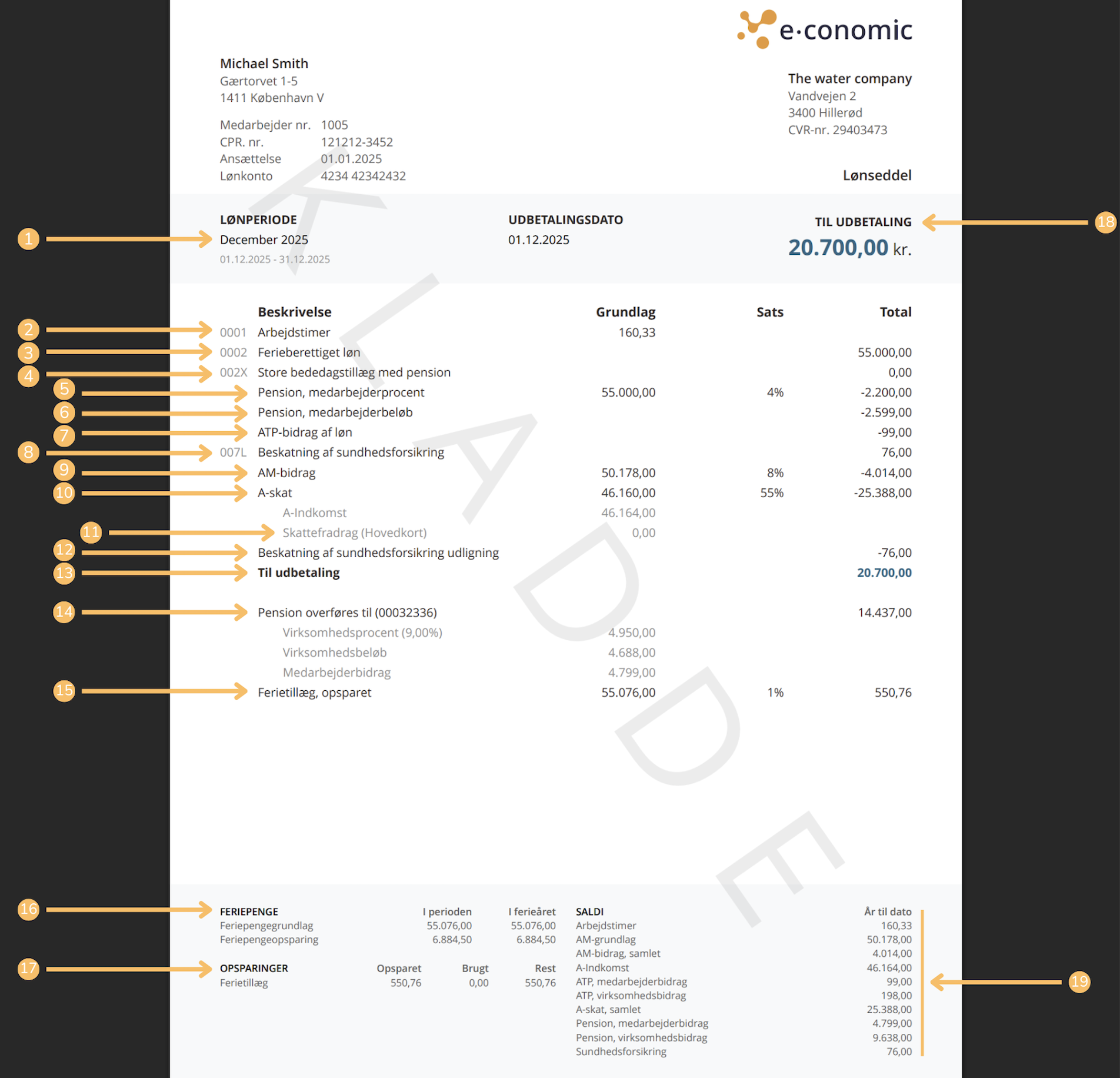
1. Pay period and payout date (Lønperiode og udbetalingsdato)
This shows the period you are being paid for and when your salary is paid out.
2. Working hours (Arbejdstimer)
The number of hours you have worked in the pay period.
3. Holiday pay qualifying salary (Ferieberettiget løn)
Your gross salary before deductions such as labour market contribution (AM-bidrag) and tax. The salary is calculated based on working hours in the pay period and your pay rate.
4. Payout of savings (Udbetaling af opsparing)
Any savings paid out, such as holiday supplements or other accruals.
5. Pension, employee percentage (Pension, medarbejderprocent)
The percentage of your salary that you contribute to your pension.
6. Pension, employee amount (Pension, medarbejderbeløb)
The actual amount you contribute to your pension.
7. ATP contribution from salary (ATP-bidrag af løn)
Mandatory Danish pension contribution (ATP). This is a mandatory pension scheme for all employees over 16 years old. The pension is automatically paid out when you retire.
8. Taxation of employee benefits: health insurance (Beskatning af personalegoder: Sundhedsforsikring)
Tax applied to benefits such as health insurance.
9. AM contribution (AM-bidrag)
Labour market contribution deducted from your salary at 8 percent.
10. A-tax (A-skat)
Income tax deducted from your salary, after your tax deduction has been applied.
11. Tax deduction (Skattefradrag)
Your personal tax deduction, which is deducted from your income before your A-tax is calculated.
12. Adjustment: Health insurance (Udligning: Sundhedsforsikring)
Adjustment of the employee benefits that you have been taxed on, but which are not to be paid out and are therefore deducted again (see item 8).
13. Amount paid out (Til udbetaling)
The amount you receive in your account after tax and other deductions have been subtracted.
14. Pension transferred to (Pension overføres til)
Your own pension contribution as well as your employer’s contribution for this pay period. The total amount is paid into your pension scheme.
15. Holiday allowance, accrued (Ferietillæg, opsparet)
Holiday allowance accrued in the pay period. You can see the calculation of your holiday pay in item 16.
16. Holiday account (Ferieregnskab)
Here you can see amounts for how many holiday days you have earned and taken, as well as any transferred holiday days from a previous holiday year.
17. Savings (Opsparinger)
Here you can see a total overview of your savings, year to date. You can see your savings from this pay period in item 15.
18. Amount paid out (Til udbetaling)
“Amount paid out” refers to the amount you receive after tax and other deductions have been subtracted.
19. Balances (Saldi)
The total balances for the current year. These accumulate for each pay period.
When you understand the structure of your payslip, it becomes easier to follow changes from month to month and to identify if something is missing.
If you have questions about your salary, you should always contact your employer or bookkeeper. They can help explain the entries and correct any errors.
Your payslip is your documentation of what has been paid out to you, and with a bit of insight, it becomes easy to keep track of your own salary information.
Var denne artikel nyttig?
Bliv e-conomic Insider